Mind your Ps and Qs
In RSA, a small e value can be problematic, but what about N? Can you decrypt this?
Download the file.

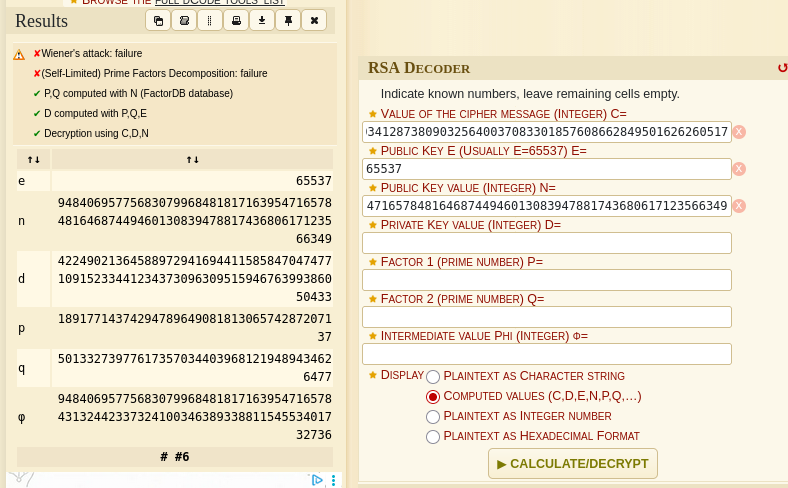
Use https://www.dcode.fr/rsa-cipher to obtain the values of p and q.
1
2
3
4
5
6
7
8
9
10
11
12
13
14
15
16
17
18
19
20
21
22
23
24
25
26
27
28
29
30
31
32
33
def long_to_bytes(n):

return n.to_bytes((n.bit_length() + 7) // 8, 'big')


n = 948406957756830799684818171639547165784816468744946013083947881743680617123566349

e = 65537

c = 15341890103764929939105506004034128738090325640037083301857608662849501626260517

p = 1891771437429478964908181306574287207137

q = 501332739776173570344039681219489434626477


phi = (p - 1) * (q - 1)

# modular inverse

d = pow(e, -1, phi)


m = pow(c, d, n)


print(m)

print(long_to_bytes(m)[::-1])
Use this code to decrypt the ciphertext.
Factoring \(n\) into \(p\) and \(q\) lets you calculate \(\varphi(n) = (p-1)(q-1)\) and the private exponent \(d = e^{-1} \bmod \varphi(n)\). The script then recovers the message integer with pow(c, d, n) and converts it to bytes. Its final [::-1] reverses the byte order. See the RSA decryption primitive for the modular decryption operation.

This reveals the flag!
This post is licensed under CC BY 4.0 by the author.